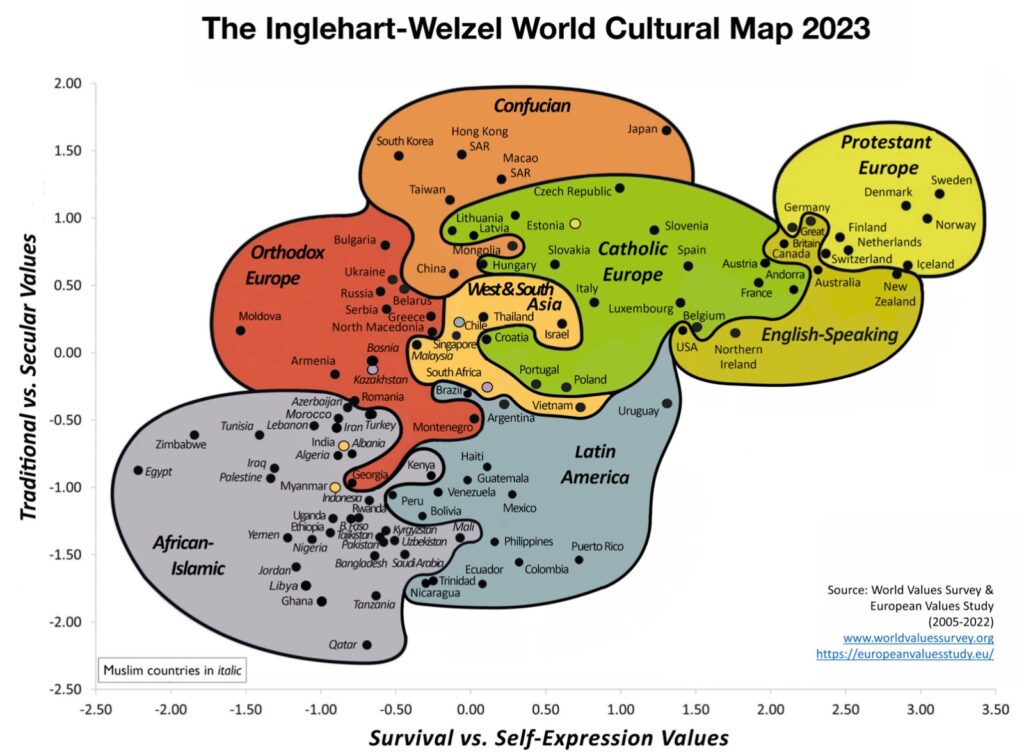
In the Age of Cross-border political, economic, and social pollination, societies are becoming more interdependent than ever before. They are also grating against each other as never before because of the different ways of thinking and mores that reflect the civilisational values of their respective cultures.
Cultural Intelligence (CQ) is an indispensable tool for understanding these values and explaining why people think and behave the way they do. It is vital to understand them to promote seamless cultural interaction and achieve specific objectives, whether economic (e.g., business), social (e.g., professional or personal relationships), or political (e.g., diplomacy).
CQ is a young profession. David Livermore of the Cultural Centre, based at the University of Michigan, has been instrumental in raising awareness of it on the global stage, particularly in business. I have attended his workshops at various locations and have qualified as a certified CQ practitioner. I have conducted CQ workshops across the commercial and social spectrum.
There is now no doubt that in the second quarter of the 21st Century, the World Order established in the wake of the Second World War is undergoing an upheaval across the spectrum of human activities. In the Age of (dis)Information and Mass Travel and Migration, conflicts and differences among cultures are becoming more pronounced, and with that, CQ’s role is becoming increasingly relevant.
One aspect of this transition across the world stage is that different values and behavioural traits are more visible at the street level, i.e., more pronounced, physically and vocally, for all to see – often leading to further polarisation and conflicts at the local levels.
Until now, CQ education has been aimed at the upper rungs of organisational management, whether in business, academia, government (diplomacy), or NGOs. This stems from their managers’ awareness of the need for cultural lubricants to advance their objectives.
However, it is now increasingly evident that upgrading the Cultural Quotient is also vital at the ground, community level to negate the ignorance that prevails about the ‘other’ on the street. In the Age of Information, disinformation is being propagated exponentially, and emotional and intellectual conflicts among people are multiplying. Awareness of differences in civilisational mores – why the ‘others’ think and behave the way they do – is becoming vital.
Here is a practical example of differences in social behaviour, and how CQ can help minimise potential misunderstandings in daily life.
Australia has been a beacon of Multiculturalism’s success worldwide. Now, however, stresses and strains are showing across the societal board. One major cause centres on Indian immigrants. India now supplies the most migrants, near-doubling since 2014. They constitute over 1 million in the national population of 27 million. There is considerable anecdotal evidence that Australians, including the First Nation peoples, are finding the Indian mores difficult to digest. A visible social divide is emerging.
I have randomly selected 15 common modes of Australian and Indian behaviour and thought that illustrate this gap. Each indicator represents a (respective) civilisational value, but here my only aim is to draw attention to why negative perceptions of Indian public behaviour are emerging. See:
https://dmm.downloadingmymind.com/indians-in-australia-the-great-social-divide/
CQ education can bridge the gap at the street level between immigrant Indians and the community’s prevailing way of life.
It is in this context that I have decided to establish Australia’s first Cultural Intelligence Centre. I am in talks with a couple of Australian Universities towards this end.
The Centre will nurture and deliver Cultural Intelligence (CQ) skills at the grassroots level, targeting high-ethnic-interaction environments such as schools, healthcare facilities, government service counters, community groups, and NGOs.
The Centre will also provide Consultancy services to businesses, academia and governments to augment its financial self-sustainability.
The profession of CQ now must descend from boardroom heights to everyday ground-level practice. Countries like Australia urgently need to recharge their social systems to safeguard social cohesion, enhance cross-ethnic dialogue, and ease tensions from conflicting cultural norms and mindsets—transitioning from Multiculturalism (accepting the ‘other’) to true Interculturalism (understanding the ‘other’).